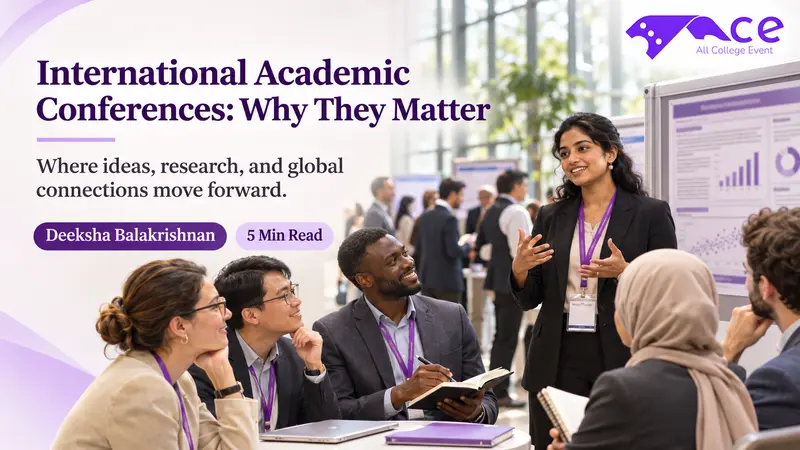
Am I actually going to get something out of this, or is it just another line on my resume? That question sits behind almost every decision to attend an international academic conference, whether you're a student weighing your first paper submission, a faculty member deciding which event is worth the travel budget, or a professional trying to figure out if this is where real industry connections happen.
It's a fair question. International academic conferences have multiplied in number over the last decade, and not all of them offer the same value. Some genuinely shape careers - leading to collaborations, publications, job leads, or a completely new research direction. Others are little more than a registration fee and a certificate. This guide breaks down what these conferences actually are, why they matter differently depending on who you are, and how to tell a genuinely valuable one from a forgettable one.
Key Takeaways
International academic conferences bring together researchers, faculty, and professionals across countries - the value comes from the quality of review, speakers, and community, not the "international" label alone.
What you gain depends heavily on your role - students gain feedback and exposure, faculty gain collaboration and institutional visibility, professionals gain networks and market insight.
The most common mistake is treating every conference as equally valuable - a strong evaluation checklist matters more than a flashy name.
Real career value tends to come from consistent, selective participation rather than attending as many events as possible.
What Are International Academic Conferences Really?
At its core, an international academic conference is a structured gathering - in person, online, or hybrid, where people from more than one country come together to present research, share findings, or discuss developments in a shared field. That's the basic idea. But the real value isn't in the definition - it's in the execution: who's reviewing the papers, who's actually speaking, and what happens to the work once it's presented.
Broadly, these conferences fall into a few categories:
| Conference Type | Primary Focus | Typical Format | Best Suited For |
| Research/Academic Conference | Original research papers, peer review | In-person or hybrid | Students, faculty, research scholars |
| Industry/Professional Conference | Applied insights, product trends, panels | In-person, hybrid, or online | Working professionals, industry researchers |
| Symposium | Focused discussion on a narrow theme | Usually smaller, in-person | Faculty, specialists in a sub-field |
| Workshop-style Conference | Hands-on sessions, skill-building | In-person or online | Students and early-career professionals |
Am I looking for a place to present peer-reviewed research, or somewhere to build practical skills and connections? That single question usually points you toward the right category before you even start comparing individual events.
Why Do International Academic Conferences Actually Matter?
Will this conference genuinely move something forward for me, or am I just chasing the idea of attending one? For most people, the honest pull is global exposure - a chance to be seen and heard beyond their own campus or company. For students specifically, it usually comes down to something more direct: will this give my career the uplift it needs?
For Students
If I'm a student, what am I really gaining here? Mainly three things - structured feedback on my work from people outside my own institution, exposure to research directions I hadn't considered, and early practice explaining complex ideas simply - a skill that matters well beyond academics. Presenting at a genuinely peer-reviewed conference also adds real weight to a research profile, particularly for higher studies or research-focused roles, since it shows the work held up under outside scrutiny, not just a professor's approval.
For Faculty
For faculty, the calculation shifts. Am I attending to build my own research profile, to represent my institution, or to find collaborators for a joint project? International conferences are one of the few settings where faculty from different institutions and countries interact directly, often leading to co-authored papers, joint research proposals, or invitations to review and mentor. There's also an institutional angle - sustained faculty participation in credible international conferences contributes to a department's visibility and academic standing over time.
For Global Professionals
If I'm a working professional, is this conference actually where the useful conversations happen, or is it mostly ceremonial? The honest answer is, it depends on the event's format. Conferences with strong panel discussions, workshops, and structured networking sessions tend to deliver real value - market insight, potential hires, partnership leads. Ones that are purely lecture-format with no interaction time tend to deliver much less, regardless of how prestigious they sound.
Real-World Scenarios: What Attending Actually Looks Like
Scenario 1: A student's first paper. A final-year engineering student submits a paper based on their capstone project to a peer-reviewed conference in their field. The review process flags a gap in their methodology they hadn't noticed. They revise, resubmit, get accepted, and present to a room that includes researchers working on adjacent problems. One of them later shares a dataset that becomes useful for the student's next project. The real value wasn't the certificate - it was the reviewer feedback and the unplanned connection afterward.
Scenario 2: A faculty collaboration. A professor attends an international conference primarily to present a paper, but ends up in a longer conversation with a researcher from another country working on a similar problem from a different angle. That conversation, followed up over email, eventually turns into a joint research paper. Neither side went in looking for a co-author - it emerged from being in the room.
Scenario 3: A professional's networking win. A working professional attends an industry-facing conference mainly to understand where their sector is heading. During a panel Q&A, they ask a specific, well-framed question, which leads to a conversation afterward with someone hiring for a role that matches their background. The conference itself didn't offer the job, the conversation it enabled did.
None of these outcomes were guaranteed. But none of them would have happened without showing up prepared, and without picking a conference structured well enough to allow that kind of interaction.
Common Mistakes and Misconceptions
Mistake: Assuming "international" automatically means credible.
The word "international" describes reach, not quality. A conference can technically have attendees from multiple countries and still have a weak review process. Always check the review process and organising body separately from the label.
Mistake: Registering without checking the review process.
If a conference accepts every submission with no real feedback, the acceptance means very little. A genuinely useful conference will have a visible timeline for review, not instant acceptance right after payment.
Misconception: Conferences are only for advanced researchers.
Many international academic conferences run specific tracks for students and early-career researchers, including poster sessions and shorter presentation formats designed for people presenting their first paper.
Misconception: The certificate is the main outcome.
The certificate is a byproduct, not the goal. The actual value : feedback, connections, exposure to new ideas : comes from how you engage during the event, not from the piece of paper you leave with.
Mistake: Attending too many conferences without depth.
Am I building genuine expertise and connections, or just collecting attendance? Selective, well-prepared participation in a few strong conferences tends to matter more for a research or career profile than attending many weakly vetted ones.
How to Evaluate Whether a Conference Is Worth Attending
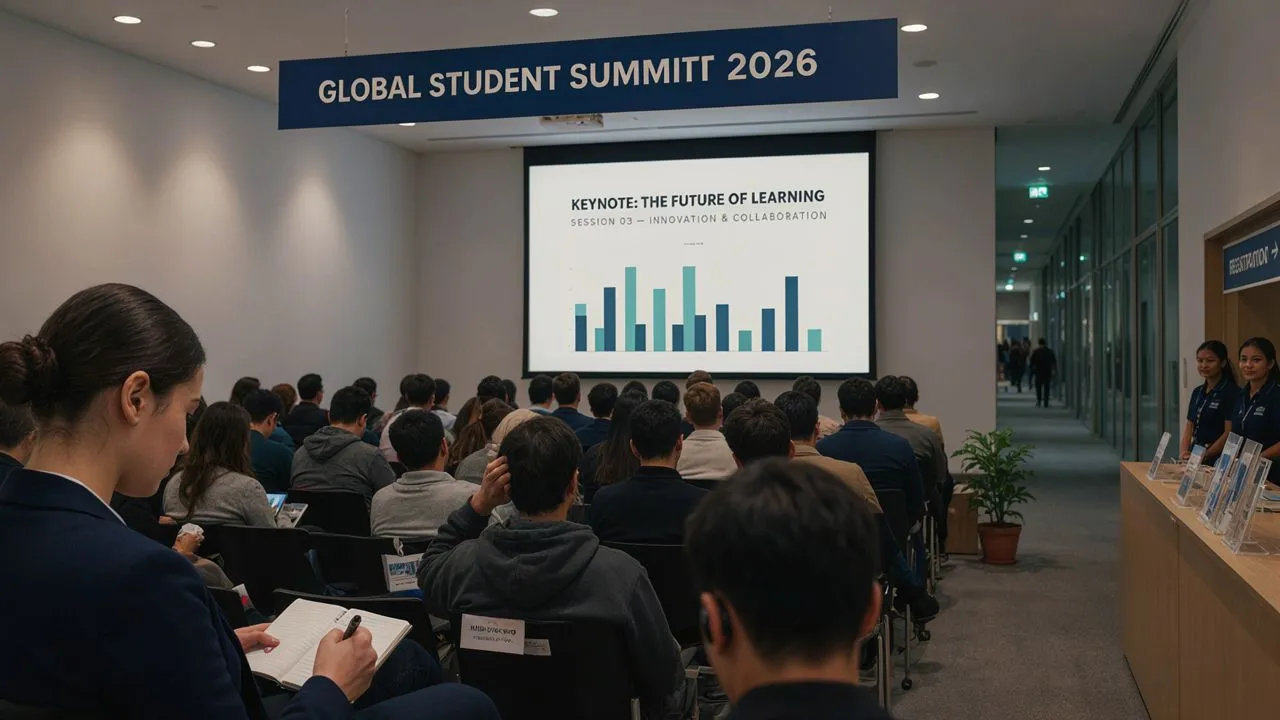
Before registering anywhere, it helps to run through a short evaluation checklist:
Check the organizing body: a known university, professional society, or established research group carries more weight than an unfamiliar private organizer with no visible track record
Look at the review process: is there a defined timeline between submission and acceptance, or does everything get approved immediately?
Verify indexing claims independently: if a conference claims its proceedings are indexed in a recognized database, confirm this directly through that database rather than taking the organizer's word for it
Look at past editions: a conference in its later editions with a visible archive of past speakers and papers is generally more trustworthy than one with no history
Match the format to your goal: a research-heavy event suits someone chasing publication value; a panel-and-workshop-heavy one suits someone chasing networking or applied learning
Conference vs. Symposium vs. Workshop
| Attribute | Conference | Symposium | Workshop |
| Scope | Broad, multi-track | Narrow, single theme | Skill-specific, hands-on |
| Duration | Usually 2-3 days | Often 1 day | Few hours to 1 day |
| Output | Papers, proceedings | Focused discussion, sometimes proceedings | Practical skills, sometimes a certificate |
| Ideal for | Students, faculty, researchers presenting original work | Specialists wanting deep discussion in one area | Early-career participants building specific skills |
Once you've run a topic or event through this checklist, the decision usually becomes obvious : either it clearly fits what you're trying to achieve, or it clearly doesn't.
Tools and Actionable Next Steps
Build a simple submission tracker: a spreadsheet with conference name, submission deadline, review process, and indexing claim helps you compare options instead of relying on memory
Prepare a reusable short bio and abstract template: most submissions ask for similar information, and having a template ready saves time across multiple applications
Set calendar reminders for call-for-papers windows: many strong conferences open submissions several months in advance, and missing the window is one of the most common avoidable mistakes
Cross-check indexing and credibility directly: through databases like Scopus or through the relevant professional body's official site, rather than relying solely on the conference's own claims
Conclusion
International academic conferences aren't inherently valuable just because of the label - their worth comes from the quality of the review process, the people in the room, and how deliberately you engage once you're there. Whether you're a student presenting your first paper, a faculty member scouting collaborators, or a professional reading where your industry is heading, the same underlying question applies - Am I picking this conference because it genuinely fits my goal, or just because it's the next one on the calendar?
Explore verified international academic conferences by field, format, and audience type on AllCollegeEvent.com, and start building a conference history that actually adds up to something.
Ready to Join Your Next College Fest?
Discover upcoming technical, cultural, sports and workshop events near you.
Explore Events Now