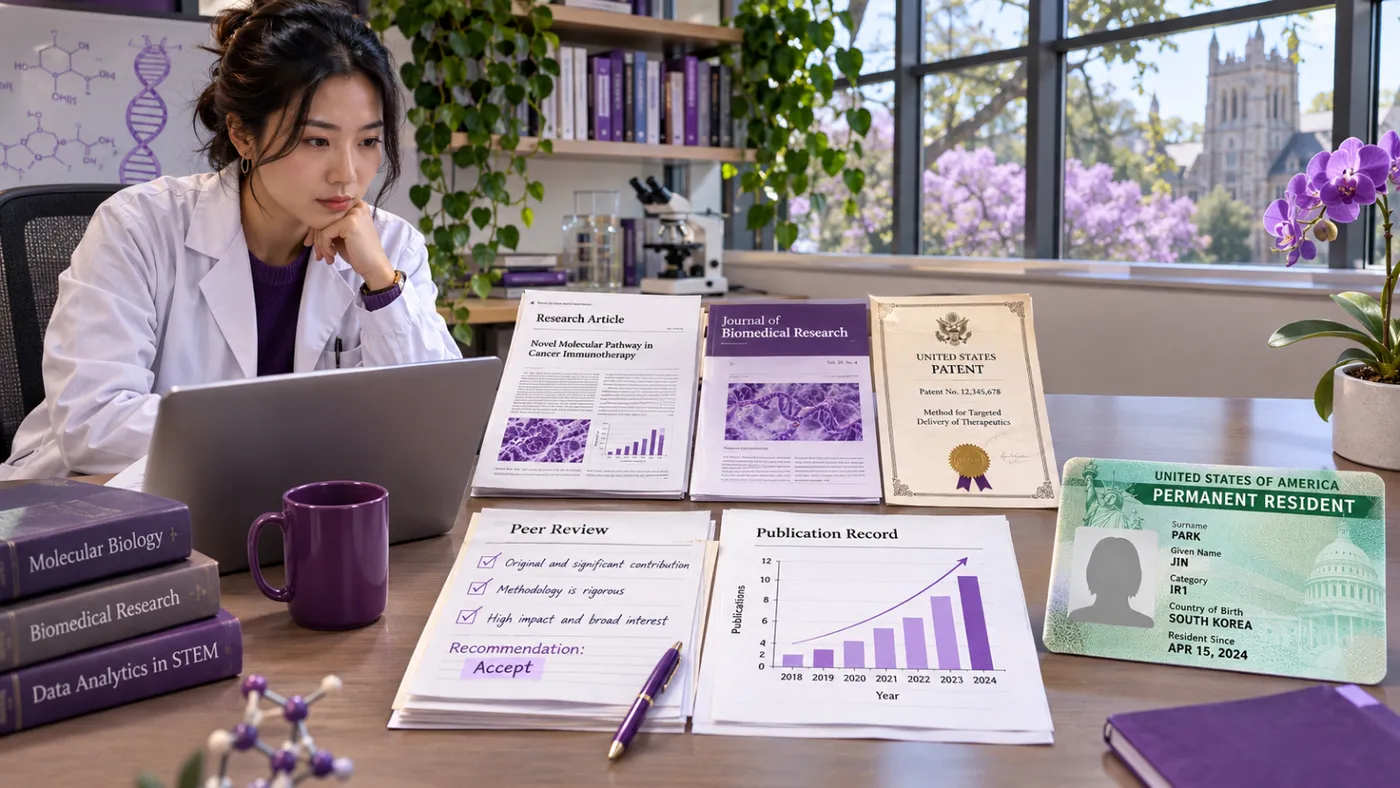
Let’s start with the part most blogs sugarcoat: the EB-1 visa for STEM professionals is a high bar, and USCIS makes no apologies for it. This is America’s first-preference green card, reserved for people who can prove they rank among the small percentage at the very top of their field. You need to satisfy at least 3 of 10 strict criteria, survive an officer trained to be sceptical, and do it all on paper. Plenty of genuinely talented researchers and engineers get refused every year - not because they lack ability, but because they can’t prove it the way USCIS demands.
So here’s the honest question to sit with before anything else: do you meet the criteria today? For most readers, the answer is “not yet” - and that’s exactly why this guide exists. Because this is the other truth, the EB-1 visa for STEM professionals isn’t a lottery or a fame contest.
Every one of those 10 criteria - publications, judging, awards, original contributions, critical roles - is something you can deliberately build over 3-5 years. The researchers who win approvals aren’t a different species, they started collecting evidence early and never stopped.
This guide walks you through what the EB-1 visa for STEM professionals really requires, where you likely stand right now, and how to close the gap - criterion by criterion, with proof USCIS can’t argue with.
So, before you scroll further - have you ever actually measured your profile against the EB-1 criteria, or have you just assumed you’d fall short?
EB-1 Eligibility Requirements: Who Actually Qualifies?
First, the lay of the land. The EB-1 is the first-preference employment-based green card for STEM professionals and other high achievers, and it comes in three flavors:
| Category | Who It's For | Job Offer Needed? | Self-Petition? |
| EB-1A (Extraordinary Ability) | EB-1C (Multinational Manager/Executive) | Yes | Yes |
| EB-1B (Outstanding Professor/Researcher) | Academics with 3+ years of research or teaching experience | Yes (permanent research/teaching role) | No (employer files) |
| EB-1C (Multinational Manager/Executive) | Managers transferred to a US branch of their company | No | No |
For most readers of this blog - PhD scholars, postdocs, engineers, and industry researchers - the EB-1 eligibility requirements that matter are EB-1A and EB-1B. And here's why the EB-1 visa for STEM professionals is such a big deal compared to other routes:
No labor certification (PERM). You skip the slow, employer-driven labor market test entirely.
EB-1A needs no employer at all. It's a self-petition green card - you file for yourself.
Faster queues. Even with retrogression for India and China, the EB-1 line moves years faster than EB-2 or EB-3.
A note for Indian readers: as per the November 2026 Visa Bulletin, the EB-1 India final action date is February 1, 2023, with a filing date of July 1, 2024. There is a wait - but it's measured in a few years, not the decade-plus backlog of EB-2 India. That alone makes the EB-1 visa for STEM professionals worth planning for early.
EB-1A Extraordinary Ability Criteria Checklist
This is the point where most STEM professionals either get excited or give up too soon. USCIS lists ten EB-1A extraordinary ability criteria, and you need to satisfy at least three of them (unless you've won a one-time major award like a Nobel Prize - in which case, why are you reading this?).
The ten criteria, translated into plain STEM language:
Nationally or internationally recognized prizes/awards – best paper awards, major hackathon wins, national-level research prizes.
Membership in associations requiring outstanding achievement – senior memberships like IEEE Senior Member, not pay-and-join societies.
Published material about you – media coverage, interviews, or articles discussing your work (not written by you).
Judging the work of others – peer reviewing for journals, serving on conference program committees, judging student competitions.
Original contributions of major significance – the heart of every EB-1 visa for STEM professionals petition (more on this below).
Scholarly articles – journal papers, conference proceedings, book chapters.
Artistic exhibitions – rarely used by STEM applicants.
Leading or critical role in distinguished organizations – tech lead on a flagship product, lab lead, founding engineer.
High salary relative to others in your field.
Commercial success in performing arts – again, rarely relevant for STEM.
Notice something? Criteria 4, 5, 6, and 8 are things many researchers and engineers are already doing - reviewing papers, publishing, leading projects. The gap isn't talent; it's documentation. In practice, how to qualify for EB-1 comes down to how early you start collecting proof.
EB-1B Outstanding Researcher: The Academic's Route
If your career lives inside universities or R&D labs, the EB-1B outstanding researcher category might feel like a more natural fit. Instead of proving you're among the very top of your entire field, you prove you're internationally recognized as outstanding in a specific academic area.
The EB-1B checklist looks like this:
At least 3 years of research or teaching experience in your academic field.
A permanent job offer - a tenure-track position, or a comparable permanent research role at a university or a private company with an established research department.
Evidence meeting at least 2 of 6 criteria: major awards, memberships in selective associations, published material about your work, judging others' work, original research contributions, and authorship of scholarly books or articles.
The trade-off is obvious. EB-1B has a lower evidence bar than EB-1A, but your employer files the petition - it's not a self-petition green card. If you switch jobs mid-process, you may have to restart. That's why many applicants pursuing the EB-1 visa for STEM professionals file EB-1A independently even while their university prepares an EB-1B, running both in parallel.
Quick gut-check, If you're a postdoc with 10+ publications, a few hundred citations, regular peer-review invitations, and a supportive department - EB-1B is very realistic. If you're in industry with no permanent "research" title, EB-1A (or EB-2 NIW, coming up next) is usually your lane.
EB-1 vs EB-2 NIW: Which Path Should You Pick?
This is the most common crossroads question on Quora and Reddit immigration threads, so it deserves a straight answer. The EB-2 NIW (National Interest Waiver) is the EB-1's friendlier younger sibling - a self-petition green card with a lower bar, where you show your work has substantial merit and national importance to the US.
| Factor | EB-1A | EB-2 NIW |
| Evidence bar | Very high (top of field) | Moderate (well-positioned to advance important work) |
| Self-petition | Yes | Yes |
| Approval difficulty | Harder; RFEs common | More forgiving for early-career profiles |
| Queue for India (Nov 2026) | Final action: Feb 1, 2023 | Final action: Nov 1, 2013 |
| Queue for most countries | Current | Current |
| Premium processing | 15 business days | Available |
Read that India row again. The EB-2 India backlog sits more than a decade behind, while the EB-1 queue is only a few years deep. For Indian-born applicants, that gap is exactly why the EB-1 visa for STEM professionals is worth stretching for - a "harder" petition that gets decided and delivered years earlier beats an "easier" one stuck in a 10+ year line.
A popular strategy among STEM applicants: file EB-2 NIW first to lock a priority date and build confidence, then upgrade to EB-1A once your citations, reviews, and media coverage mature. Your earlier priority date carries over - so nothing is wasted.
EB-1 Evidence Documentation
One mindset shift separates approved petitions from rejected ones: USCIS officers are not experts in your field. The officer reading your file may not know what a transformer model, a CRISPR edit, or a 5G beamforming algorithm is. Strong EB-1 evidence documentation translates your technical impact into plain, verifiable claims.
Think of every claim in your petition as needing three layers:
The achievement - "I developed an algorithm."
The independent proof - the published paper, the patent number, the award certificate, the citation report.
The significance - who adopted it, who cited it, what changed in the field or industry because of it.
Original Contributions EB-1: Proving "Major Significance"
Original contributions are the backbone criterion for almost every STEM petition, and also the one USCIS questions most. To prove original contributions EB-1 style, gather:
Citation evidence - Google Scholar/Scopus reports, highlighting who cites you (top labs, Fortune 500 R&D teams) and how (building on your method vs. a passing mention).
Adoption evidence - emails, licenses, or documentation showing companies, hospitals, or labs actually using your work.
Patents with implementation - a granted patent is good; a granted patent that a product ships with is gold.
Expert testimony - independent researchers explaining, in writing, why your contribution changed how people work.
Start a simple "evidence folder" today - every review invitation, award email, citation alert, and media mention goes in. In the future you (and your attorney) will be grateful.
EB-1 Recommendation Letters: Your Expert Witnesses
If evidence documents are your facts, EB-1 recommendation letters are your expert witnesses. A typical petition includes 5–8 letters, and quality beats seniority every time. What actually works:
Independent recommenders matter most. Letters from your PhD advisor and manager are expected - but USCIS gives far more weight to experts who never worked with you and still know your work through citations, conferences, or adoption. Aim for at least half your letters to be independent.
Specific beats glowing. "Dr. X is a brilliant researcher" does nothing. A concrete line - for example, "her 2023 segmentation method cut our annotation time by 40%, and we now use it in our clinical pipeline" - wins cases.
Each letter should map to a criterion. One letter supports original contributions, another supports your critical role, another your judging record - don't make eight people say the same thing.
The recommender's credibility must be documented too. Attach each expert's short bio or CV showing why their opinion counts.
A practical tip for anyone targeting the EB-1 visa for STEM professionals: your future independent recommenders are people you meet now - at conferences, workshops, competitions, and peer-review panels. Every genuine professional interaction today is a potential credibility witness three years from now. Networking isn't a soft skill in this journey; it's evidence generation.
How to Qualify for EB-1: A Roadmap You Can Start Today
Most immigration blogs skip this part: how to qualify for EB-1 isn't a 6-month sprint before filing - it's a 3–5 year profile-building project. And almost every building block starts with opportunities that already exist around you, especially if you're still in college or early in your career in India.
Year 1 & 2: Build the raw material
Publish consistently - journal articles, conference papers, and well-indexed proceedings. If writing for publication feels intimidating, structured journal publication programs can help you turn project work into citable papers.
Present your research anywhere credible, including online conferences and virtual symposiums - remote presentations still count as evidence of recognition and are far easier to access from India.
Compete seriously. Winning or placing in trending national competitions and hackathons builds your "awards" criterion while you're still a student.
Year 2 - 4: Shift from participant to authority
Start peer reviewing for journals and conferences (your publication record earns you invitations).
Judge student competitions and project expos. A platform like All College Event, an AI-driven event intelligence platform, makes it easy to discover judging and mentoring opportunities across institutions nationwide. Its AI event discovery surfaces the hackathons, paper presentations, and symposiums where your expertise is actually needed - instead of scrolling ten WhatsApp groups.
Chase "published material about you": university newsletters, tech media features, podcast interviews about your work.
Year 4 - 5: Package and position
Pull citation reports, adoption proof, and salary benchmarks.
Line up independent recommenders from your conference and review network.
Decide: EB-1A now, EB-2 NIW now with an EB-1A upgrade later, or EB-1B through an employer.
For faculty and institutions reading this: students don't become EB-1-caliber researchers by accident. Colleges that invest in research culture - through structured events, publication support, and programs like ACE College - are quietly building the next generation eligible for the EB-1 visa for STEM professionals. That's the deeper value of College Events India as a college events platform - for ambitious students, every certificate, win, and paper earned on a student event platform India trusts becomes a future exhibit.
Self-Petition Green Card: Process, Fees & Timeline (2026)
So what does filing actually look like? For an EB-1A self-petition green card, the mechanics are refreshingly simple compared to the evidence work:
File Form I-140 (Immigrant Petition for Alien Worker) with your full evidence package. Base fee: $715, plus a $300 Asylum Program Fee for self-petitioners.
Optional premium processing (Form I-907): $2,965 gets you a USCIS decision - approval, denial, or RFE - within 15 business days. For EB-1A, this is one of the best stress-reduction purchases in immigration.
Green card stage: If you're in the US and your priority date is current, file Form I-485 (adjustment of status); if abroad, consular processing via DS-260.
Wait for your final action date if you were born in India or China - India's current cutoff is in the eligibility section above; most other countries are current.
Realistic timeline for a well-prepared case: 6–12 months of evidence building and letter collection, a 15-business-day I-140 decision with premium processing (or several months to a year without it), then the queue wait depending on your country of birth. Verify current fees on USCIS.gov before filing - they changed as recently as March 2026.
A final reminder: this guide is career-strategy content, not legal advice. For borderline profiles, an hour with a qualified immigration attorney before filing is worth more than a hundred Reddit threads.
Ready to Join Your Next College Fest?
Discover upcoming technical, cultural, sports and workshop events near you.
Explore Events Now