
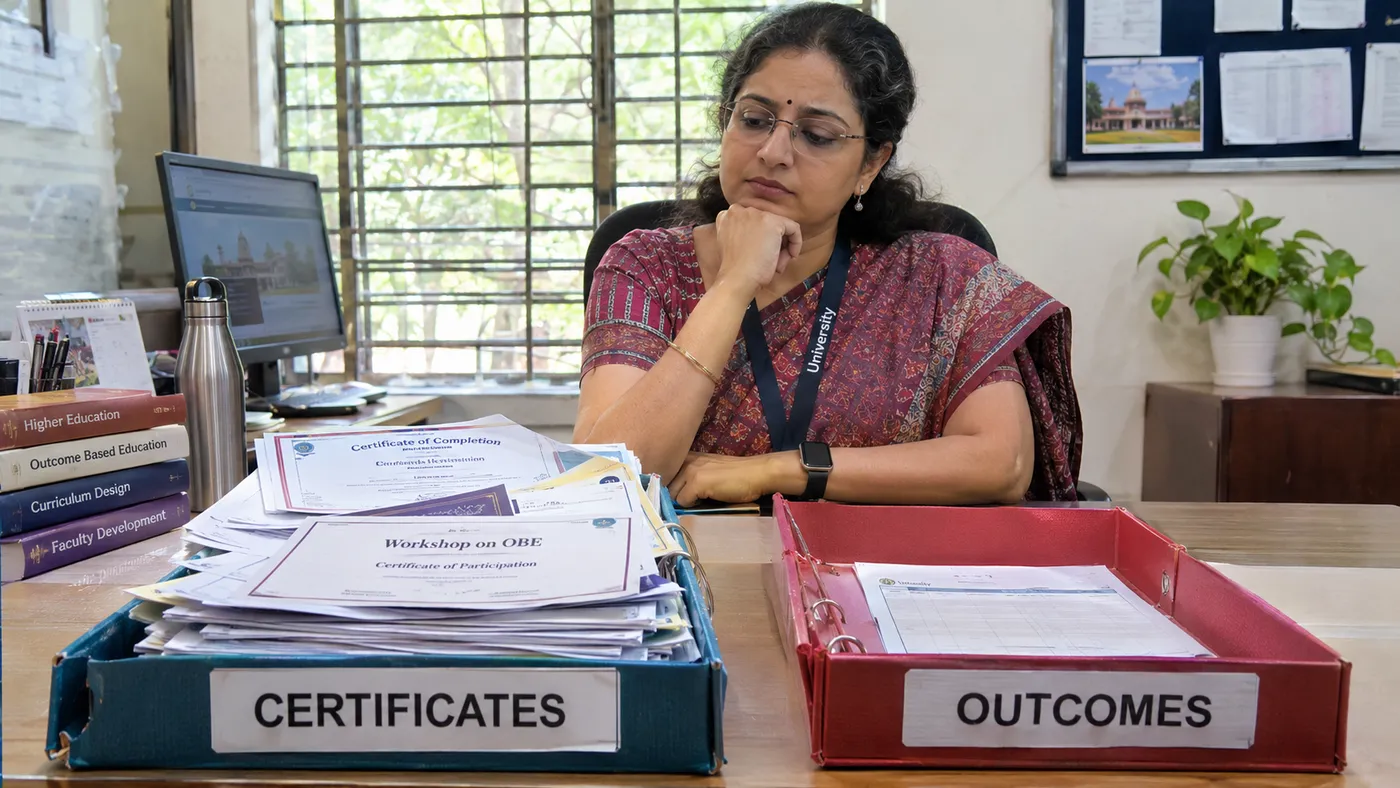
Be honest about the last FDP you attended. Did it change how you teach, research, or work - or did it add one more certificate to a folder you open only during appraisal season?
If your answer is the folder, you are not the problem. The way most of us approach faculty development programs is the problem. We register late, often for whatever is available rather than what we need. We attend between classes, half-present. We collect the certificate and return to the same routines by Monday. The program gets blamed, the cycle repeats next semester, and "FDP" slowly becomes a formality word on campus.
It does not have to work that way. Done deliberately, faculty development programs are one of the few structured chances a working teacher gets to upgrade skills, meet collaborators outside their department, and build the documented record that promotions and research careers quietly depend on. The difference between a wasted week and a career-shifting one is rarely the program itself. It is the playbook you bring to it.
This is that playbook - what STTPs and FDPs actually are, what each one gives you, how to pick the right one, and how to convert five days of sessions into outcomes that still matter a year later.
So, before reading on - when you attended your last program, did you choose it, or did it just happen to you?
STTP FDP Difference: What Each One Actually Is
The two terms get used loosely on campus, so a clear STTP FDP difference helps you choose with intent:
| Factor | FDP (Faculty Development Program) | STTP (Short Term Training Program) |
| Core purpose | Broad professional growth - pedagogy, research skills, technology, academic leadership | Focused, hands-on training in one specific technical area or tool |
| Typical duration | Commonly one to two weeks; some run longer in phases | Commonly one to two weeks, tightly scheduled |
| Teaching style | Mix of expert lectures, discussions, and activities | Lab-heavy, practice-first, project-oriented |
| Best suited for | Improving how you teach, assess, guide research, or lead | Learning a defined skill - a software, a method, an emerging domain |
| Typical organisers | Universities, academies of regulatory bodies, teaching-learning centres | Technical institutes, engineering departments, professional bodies |
| What you leave with | Wider perspective plus a recognised certificate | A usable skill plus a recognised certificate |
A simple way to remember it: an FDP develops the teacher, an STTP develops a skill. Both matter, and the strongest faculty profiles alternate between them - a pedagogy-focused FDP one semester, a technical STTP the next. Workshops, orientation programs, and refresher courses sit in the same family, and the playbook in this article applies to all of them.
STTP Benefits for Faculty: More Than a Certificate
Why should a busy teacher protect a week for this? The honest list of STTP benefits for faculty goes well beyond the paper:
Career progression requires it. Regulatory bodies and university norms in India link promotions and career advancement to documented professional training. The certificate folder you maintain casually is, in fact, a promotion file.
Skills age faster than careers. The syllabus you teach changes slowly; the industry your students enter changes every few years. Structured training is the fastest honest way to close that gap - especially in areas like AI, data tools, and new lab methods where self-study alone rarely builds confidence.
Research collaborations start here. Ask around: a surprising number of joint papers and funded proposals began as a conversation between two participants at a training program. A week with thirty faculty from other institutions is a networking event disguised as a classroom.
Teaching gets measurably better. Programs on assessment design, active learning, and instructional technology give you techniques your students feel within a month.
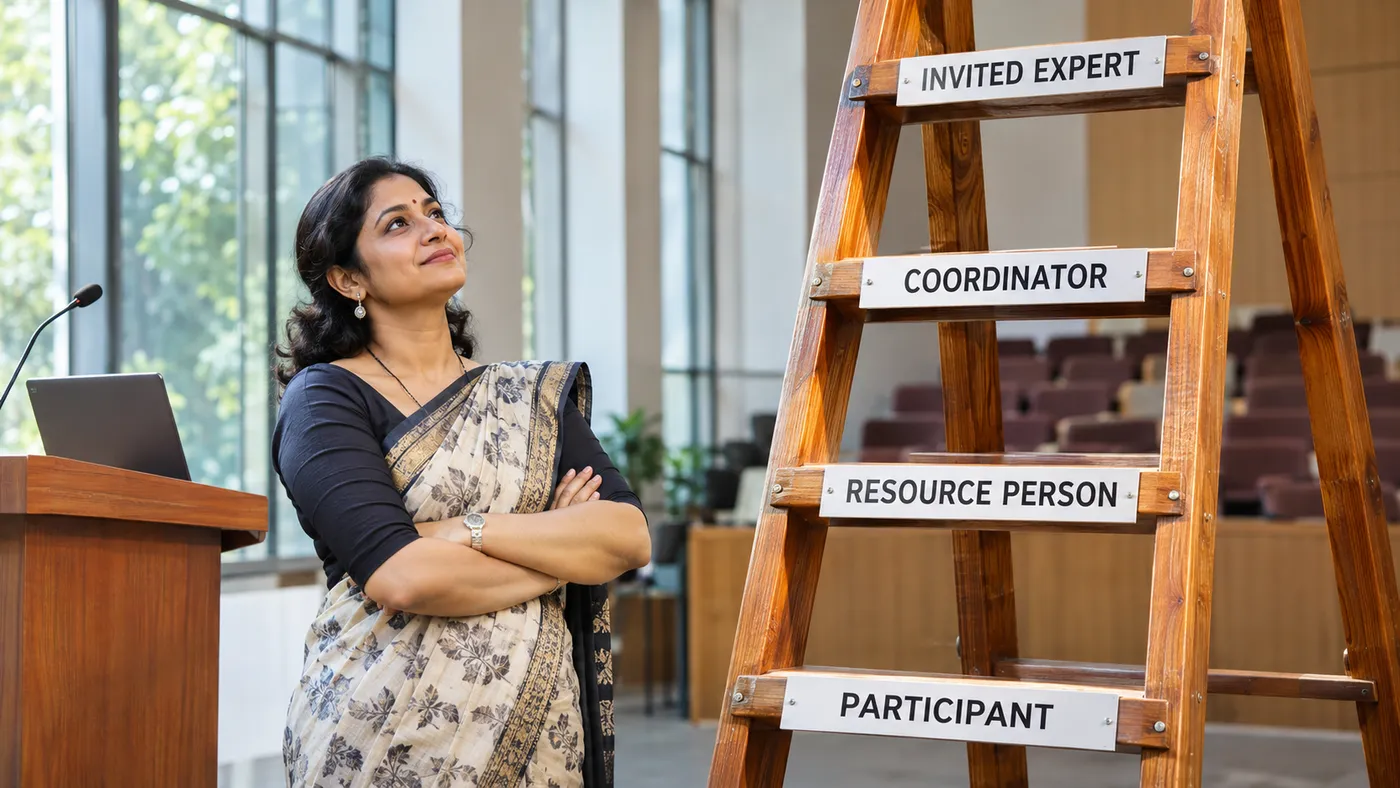
Visibility compounds. Participants become resource persons. Resource persons become coordinators. Coordinators become the names institutions invite - and every stage strengthens your academic standing.
One reframe worth adopting: stop treating these programs as obligations your institution imposes, and start treating them as the only paid weeks of your year dedicated entirely to your own growth.
Part 1: Choose Like It Costs You Something
Because it does - a week of your working life. Making the most of FDP participation starts before registration, with four filters:
Start from a gap, not a brochure. Write down the one skill gap that held you back this year. A paper you could not analyse data for. A course students rated poorly. A tool your department adopted that you avoid. The right program closes a named gap; the wrong one just fills a week.
Check the organiser and the speakers. A program run by a reputed institution or a recognised academy, with named speakers whose work you can verify, beats a vague flyer promising "eminent experts." Ten minutes of checking saves five wasted days.
Read the schedule, not the title. Titles are marketing. The session-wise schedule tells you whether the week is hands-on or lecture-heavy, and whether the depth matches your level. No detailed schedule available is itself a signal.
Match the format to your life. Online programs remove travel but demand more self-discipline; residential ones cost more time but build stronger networks. Choose deliberately rather than defaulting to whichever is easier to ignore.
And a note on timing: the best faculty training programs fill up early, because deliberate people register early. If you only discover programs through forwarded circulars the week before they start, the selection problem is really a discovery problem - more on fixing that later.
Part 2: Attend Like a Researcher, Not a Tourist
Faculty skill development during the program week comes down to a handful of habits that separate the front bench from the back:
Set one concrete target per day. Not "learn machine learning" but "leave today able to run one classifier on my own dataset." Small targets convert sessions into skills.
Do the hands-on parts yourself. In every lab session, somebody watches their neighbour's screen. That person remembers nothing in a month. Type your own commands, make your own errors, ask your own questions.
Collect people, not just notes. Introduce yourself to at least three participants from other institutions and both coordinators. Note who works on what. This list outlives every slide deck you will be given.
Ask the unglamorous questions. The question you hesitate to ask - about funding, about tools, about how the speaker actually got started - is usually the one half the room needed.
Write a daily one-paragraph log. What you learned, what you can apply, who you met. Five paragraphs at the end of the week become your action plan, and they take four minutes a day.
Part 3: The 30-Day Conversion Window
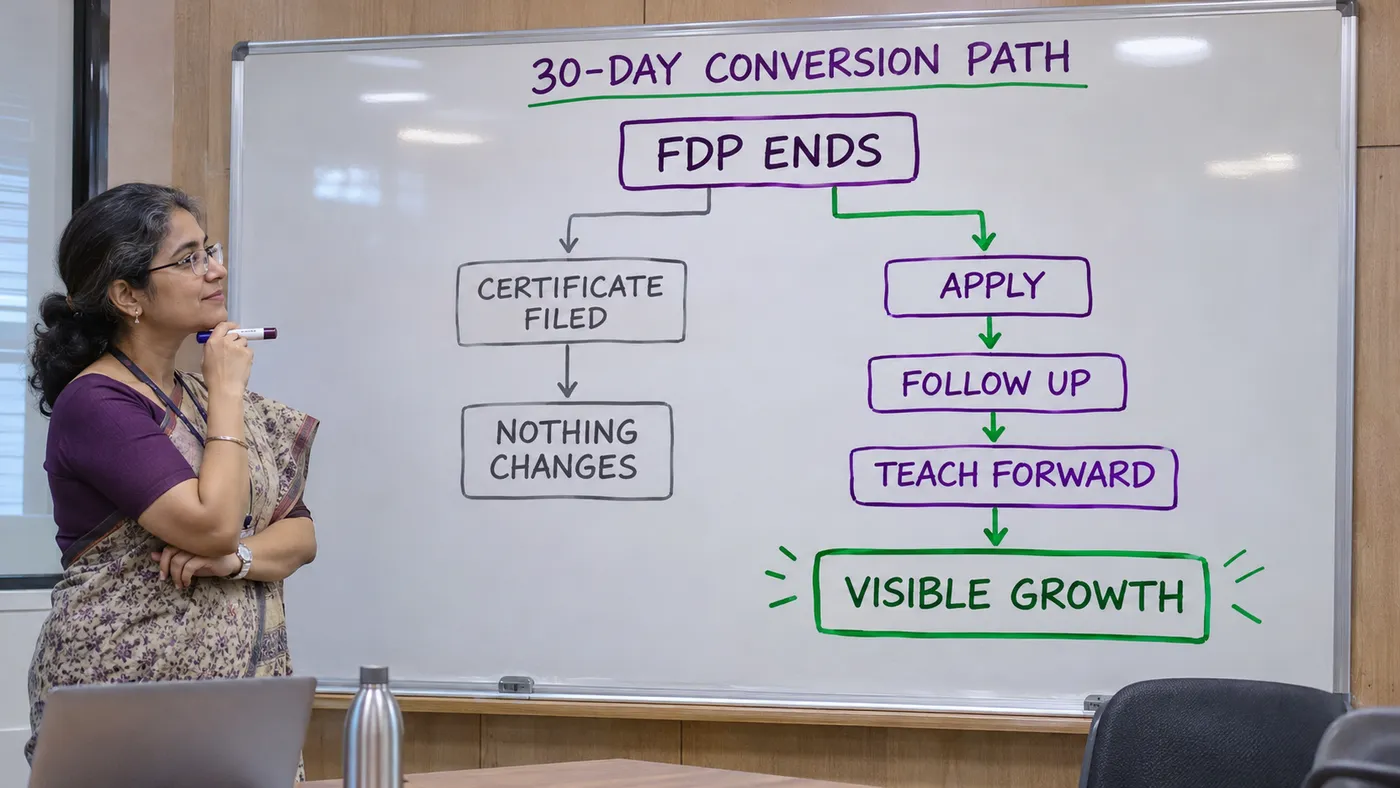
This part is where almost everyone fails, and where the entire value hides. Whatever you learned begins fading the day the program ends. Professional development for faculty becomes real only through what you do in the next 30 days:
Apply one thing in your very next class. One new assessment method, one tool, one restructured lecture. Immediate application is what moves learning from memory into practice.
Send two follow-up messages. Write to the participants or speakers you connected with while the week is still warm. A single "shall we explore that idea?" message is how collaborations actually begin.
Convert the content into one output. A revised lab manual, a new elective proposal, a workshop for your own department, or the methods section of your next paper. One program, one artefact - that is the exchange rate to aim for.
File the evidence properly. Certificate, schedule, and your one-paragraph logs go into your appraisal folder the same week - with a line on what changed in your teaching or research because of it. When promotion interviews ask what you gained, you will be the rare candidate with a specific answer.
Teach it forward within a month. A one-hour session for your colleagues forces you to organise what you learned, and it quietly positions you as the department's go-to person on that topic.
Run this conversion window after every program, and three programs a year stop meaning three certificates - they start meaning a visibly different CV.
Why Most Faculty Training Programs Change Nothing
Some honesty, because a playbook that only flatters its reader is useless. When academic faculty training fails, the causes sit on both sides:
On the participant's side: choosing by convenience instead of need, treating attendance as the achievement, skipping the hands-on work, and letting the 30-day window close with nothing applied. The playbook above exists to fix exactly these.
On the system's side: programs chosen by circular rather than by relevance, departments sending whoever is free rather than whoever needs it, and institutions counting certificates instead of outcomes. If you coordinate or lead a department, the fix is structural - map programs to the department's actual gaps, send people with a named purpose, and ask for the one-output conversion after they return.
An FDP guide for teachers is incomplete without saying this plainly: the certificate was never the product. The changed classroom, the new collaboration, and the stronger promotion file are the product. Everything else is packaging.
Finding the Right Programs Before the Deadline Passes
Every filter in this playbook assumes you can see your options in time. For most faculty, that is the broken step - programs announced on scattered websites, circulated through forwarded PDFs, and discovered three days before they begin.
Browse actively, not passively. Set a monthly half-hour to scan upcoming trending FDPs, STTPs, and workshops instead of waiting for circulars to reach you.
Use online programs to multiply access. Online FDPs and virtual workshops remove the travel barrier entirely - a faculty member in a small-town college can now train with the same experts as one in a metro.
Let discovery come to you. All College Event, an AI-driven event intelligence platform, uses AI event discovery to surface the faculty development programs, conferences, and workshops relevant to your field from across College Events India - one college events platform instead of twenty bookmarked websites.
Pair programs with publication goals. A research-methods FDP followed by structured journal publication support is one of the fastest routes from training to a tangible research outcome.
For institutions, the same logic scales. Colleges that plan faculty development as a calendar rather than an accident - through structured initiatives like ACE College - build teaching teams that improve every semester instead of every accreditation cycle. Our earlier guides on the blog - on conference presenting, journal selection, and research profile building - pair naturally with this one, because faculty growth and research growth are the same road.
Strip this playbook to one sentence: choose faculty development programs from your gaps, attend them with daily targets, and spend 30 days converting what you learned into one visible output. Teachers who work this loop two or three times a year do not just accumulate certificates - they compound. Better courses, new collaborators, stronger appraisal files, and eventually the seat on the other side of the dais, as the resource person someone else travelled to learn from.
Your students get a better teacher. Your institution gets a stronger department. And you get a career that grows on purpose instead of by accident.
So, the next program you attend - what is the one output you will have in hand 30 days after it ends?
Ready to Join Your Next College Fest?
Discover upcoming technical, cultural, sports and workshop events near you.
Explore Events Now