
Imagine this. Your guide taps the table and says, “You need a publication before the next review.” You nod and smile. Then you walk out thinking, “Journal paper or book chapter? And which one even counts?”
If you're stuck on the book chapter vs journal article question, relax. Almost every UG student, PG student, PhD scholar and young faculty member has been there. Nobody explains it in simple words, so everyone ends up asking seniors, and every senior gives a different answer.
And it matters right now, not later. Review boards, scholarship panels and promotion committees keep asking where your work is published, and whether that place is indexed. Pick the wrong one and you can lose months.
So here's the deal. I'll talk to you the way a senior would over a cup of chai. By the end, you'll know how the two differ, what each one gives you, how to publish in both, and which one to start with.
Table of Contents
Book Chapter vs Journal Article: What's the Real Difference?
Book Chapter Publication Benefits (and the Catch)
How the Journal Article Publication Process Works
How to Publish a Book Chapter
Real-Life Scenarios: What Would You Pick?
Common Mistakes and Misconceptions
Publications for Faculty Promotion and Research Profile Building
Tools and Your Next Steps
FAQs
Conclusion
Book Chapter vs Journal Article: What's the Real Difference?
Let's start with the basics, because once these are clear, everything else is easy.
What is a journal article?
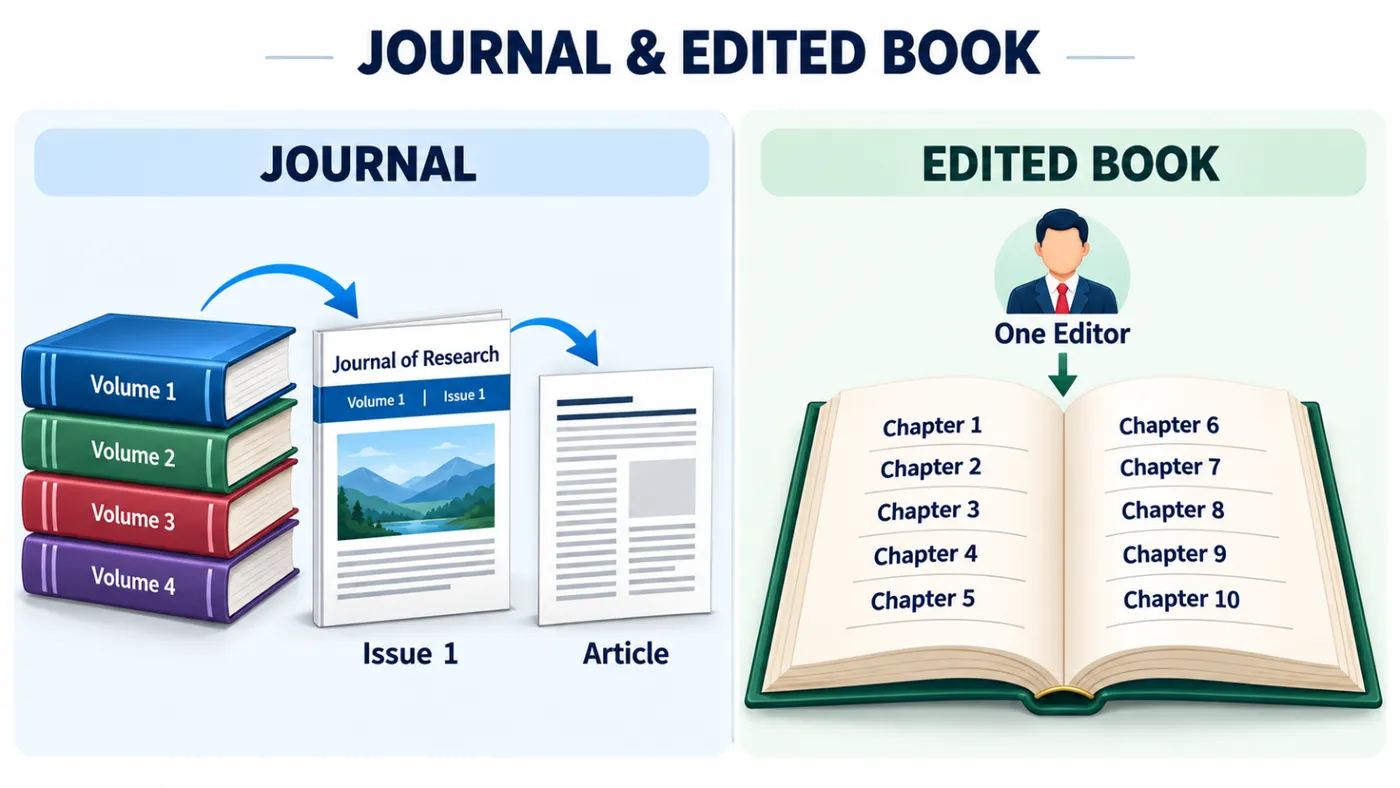
A journal article is a research paper that gets published in a journal. A journal is like a magazine for researchers, and it comes out in volumes and issues. You send your paper in. An editor checks it, and then experts in your subject read it and question it. That checking is called peer review.
Think of it like a viva, but on paper. Strangers who know your topic ask, “How did you get this result? Why this method?” Say you studied how app reminders change attendance in engineering colleges. That paper would go to an education technology journal.
What is a book chapter?
A book chapter is one piece inside an edited book. Different authors write different chapters, and one or two editors tie everything together around a single theme. You usually get in through a call for chapters or a direct invite from the editors.
Picture an edited book on digital learning in rural India. It may have fifteen chapters from fifteen teams, and yours could be a case study from one district. Chapters are usually longer and more relaxed than journal papers, so they suit reviews and big-picture writing.
Is a book chapter a research publication?
Yes, it can be. If the chapter has original research, a proper review or a solid argument, and a recognised academic publisher brings it out, it is a real publication. But how much it counts depends on the book, the publisher, the review process, and whether the book or series is indexed.
Some chapters get a serious review. Others get a quick edit and that's it. That gap is exactly why the book chapter vs journal article debate gets so heated.
What is the difference between a book chapter and a journal article?
This is the difference between a book chapter and journal article in one small table. Screenshot it and keep it.
| Journal Article | Book Chapter | |
| Lives in | A journal issue | An edited book |
| Checked by | Peer reviewers and an editor | Book editors, sometimes reviewers |
| Style | Strict: intro, method, results | Flexible: reviews, case studies |
| Impact number | ournal impact factor or CiteScore | None. Judged by publisher and indexing |
| Best for | Proving one result | Telling the bigger story |
A journal article proves one specific result through peer review, while a book chapter explains a bigger picture inside a themed book.
Which is better, a book chapter or a journal article?
Honestly, which is better, book chapter or journal article depends on what you need. If you need indexed proof for a PhD review, a journal article usually gets you there faster.
If you want to explain a big idea and meet other researchers, a chapter fits better. For most people, the book chapter vs journal article question ends with “start with one, add the other.”
Book chapter vs research paper: is there a difference?
People say “research paper” for a journal article and “chapter” for a piece in a book. So a book chapter vs research paper comparison is really the same as the one above. Both can be real research. What changes is where it lives and who checks it.
A common worry is whether book chapters count for promotion. Sometimes yes, sometimes only partly. It depends on your institution's rules and the book's indexing, so ask your department before you decide.
Book Chapter Publication Benefits (and the Catch)
Let's be fair to chapters. In most book chapter vs journal article talks they get ignored, but they have real strengths.
The first one is space. Journals push you to squeeze everything into a tight word limit. A chapter lets you tell the whole story, so the literature review you once cut down to three paragraphs finally gets room to breathe. The second is an easier way in. Many chapter invites come from conferences and symposiums, so if you present well at a college event, an editor may walk up to you afterwards.
Chapters also help with niche topics. If you write about Tamil folk media or local water management, a themed book may suit you better than a big general journal. And you get to know the other authors and editors in the book, who often become future co-authors. Some universities even count chapters for promotion or PhD records, though some don't, so check your own rules first.
Now the catch. Chapters have no journal impact factor, quality changes a lot from publisher to publisher, and some “edited books” are just pay-and-publish traps. Always check the publisher before you write a single page.
Are Scopus-indexed book chapters better?
Often, yes. Scopus covers selected books and book series, so a chapter in an indexed series can show up in its database. But not every book is indexed, and a big publisher name alone is not proof.
Check the book or series itself, not just the publisher. You can search for it on Scopus before you say yes to any invite.
How the Journal Article Publication Process Works
The journal article publication process feels mysterious until someone walks you through it. So here's the road from idea to print, in plain words.
First, you pick a journal that fits your topic. Read its aims and scope, then skim the last three issues. If nothing like your paper shows up, look elsewhere. Next, make sure the journal is genuine. Look for indexing in Scopus or Web of Science, a real editorial board, and a clear note on peer review. Then read the author guidelines carefully, because word limit, referencing style and file format all matter. Ignoring them is the quickest way to get a desk rejection.
After that, you submit your manuscript through the journal's portal with a short cover letter. The editor first decides whether your paper even goes to reviewers. If it does, the reviewers send comments and the editor gives a decision: accept, minor revision, major revision or reject.
You then fix things and reply to every comment politely, even the ones you disagree with. Finally, you check the proofs, and the journal gives your paper a DOI.
Rejection happens to everyone, even experienced authors. And a “major revision” is not a no. It just means “not yet.”
Journal impact factor importance: how much does it matter?
The impact factor is a number from Clarivate's Journal Citation Reports. It roughly tells you how often a journal's recent papers get cited. It does not tell you how good your paper is.
Still, journal impact factor importance is real for paperwork. Some scholarship forms and promotion sheets ask for it. But a good journal in a small field can have a modest number, so fit and quality come first. Scopus has its own measure called CiteScore.
How to Publish a Book Chapter
How to publish a book chapter is a different story from journals, because it runs on the editors' timeline and not on an open submission portal.
Start by finding a call for chapters. Conference mailing lists, publisher pages and event listings are good places to look. Then read the book's theme and check the editors. Have they published in this area before? Most editors want a short abstract first, not the full chapter.
Before you say yes, send four questions in writing. How is the chapter reviewed? What is the deadline? Is there any fee? Is the book or series indexed? Then write the full chapter in the editors' template, keep it original, and run a plagiarism check. Editors usually send feedback, so treat it like reviewer comments. At the end, sign the licence form and confirm the ISBN, DOI and publication date before you celebrate.
Wondering about a call for chapters, how to respond without sounding pushy? Keep your email short and polite: your name, your institution, a 200-word abstract, and one line on why your work fits the theme. That's all most editors need. And never pay a “processing fee” before checking the publisher. Some genuine open-access books do charge fees, but always verify first.
Real-Life Scenarios: What Would You Pick?
Weighing book chapter vs journal article for your own case? Here are four made-up examples. They are not real people. They just show how the thinking works.
Priya is a second-year PhD scholar. Her programme wants an indexed journal paper before the next review, so she goes for a journal article first and plans a chapter later.
Dr. Arun is an assistant professor with eight years of teaching and a promotion coming up. He reads the scoring sheet first, then aims for one indexed journal article and one chapter in an indexed series.
Meena is a final-year UG student who presented a poster at a college symposium. A chapter or a student-friendly journal is a realistic first publication for her, and she skips any invite that asks for money upfront.
Rahul works in industry and has real case studies. A book chapter suits his practical voice, and later he can turn the same data into an article.
Common Mistakes and Misconceptions
These book chapter vs journal article mistakes show up again and again. Skip them and you're already ahead.
The first is thinking “book chapters are easy.” Good books review chapters properly, and the weak ones don't, which is what makes them less valuable. The second is trusting any journal with “International” in its name. A fancy name proves nothing, so check the indexing and the editorial board. The third is chasing the highest impact factor. A journal that fits your topic beats a famous one that rejects you in a week.
Another one: believing every chapter is Scopus-indexed. It isn't. Only chapters in indexed books or series can appear there. Some people also think more publications, faster, is the plan, but quantity without quality can hurt you in a review. And never send one paper to two journals at once. Most journals forbid it, so send it to one, wait, then move on.
Most people skip this:
Before you write a single word of a chapter, ask the editor for the series name and its ISSN or ISBN. Search it in Scopus and save a dated screenshot. Indexing can change over time, and your committee may ask for proof years later.
Try the article-then-chapter move. Publish your data as a journal article, then write the chapter as the wider story and cite your own article. Just check the publisher's rules on reusing your text.
Publications for Faculty Promotion and Research Profile Building
This is where the book chapter vs journal article choice gets real, because now someone is scoring your work.
Book chapter vs journal article: which helps faculty promotion more?
It depends on your university's current rules. In many Indian systems, indexed journal articles get clearer credit, and chapters count only under certain conditions. Rules change, so read the latest scoring sheet before you choose. Check the current norms on ugc.gov.in and your university's own policy.
For publications for faculty promotion, committees want proof, not promises. Keep the indexing status of the journal or series handy, along with proof of peer review such as the acceptance mail. Keep the ISSN or ISBN, the DOI, and a copy of the title and contents page too. And note your authorship position, because first or corresponding author often counts differently.
What is the smartest order for PhD scholars?
For academic publishing for PhD scholars, a simple order works well. Start with one solid journal article, because it proves your method and gets you used to peer review. Next, write a chapter on your wider topic. Later, you can think about an edited book. So, should a PhD scholar publish a book chapter? Yes, once the first article is in good shape.
How do I do research profile building the right way?
Research profile building is mostly about being easy to find. Use the same spelling of your name everywhere. Create an ORCID ID, set up a Google Scholar profile, and link every new publication. Then anyone who finds your chapter is one click away from your articles.
Tools and Your Next Steps
You don't need a big toolkit. Use Scopus to check indexing, Journal Citation Reports for impact factors, and DOAJ or Think. Check. Submit. to test open-access journals. Add Zotero for free reference management, and run your institution's plagiarism checker before every submission.
This is your plan for this week.
Read your PhD or promotion scoring sheet and note what counts.
Pick two journals and one book series that fit your topic, and check each in Scopus.
Write one 200-word abstract, because it works for both routes. Then choose your first target and set a submission date.
And where do calls for chapters and conference papers come from? Mostly from events. A college events platform like AllCollegeEvent.com helps you find symposiums, conferences and workshops where papers and chapter invites often begin.
If you've been searching for College Events India, or a Student event platform India that keeps academic events in one place, that's the kind of tool that saves hours. Think of AI Event Discovery as a smarter search that points you to events in your field.
If you organise events, an AI-driven event intelligence platform can also help your event reach the right researchers. Become a judge or conference chair to our upcoming events.
Conclusion
Let's recap the big ideas. A journal article proves one result through peer review, while a book chapter tells a bigger story inside an edited book. Indexing and publisher quality matter more than the format. And a mix of both usually builds the strongest profile.
So the book chapter vs journal article question should feel much clearer now. You know the differences, the benefits, the steps and the traps to avoid.
Ready to find your first call for chapters or conferences? Browse upcoming academic events on AllCollegeEvent.com and shortlist two this week, whichever side of the book chapter vs journal article debate you land on. Check out our upcoming conferences and hackathons.
Now tell me: which one are you leaning towards, a book chapter or a journal article, and why? Drop it in the comments.
Ready to Join Your Next College Fest?
Discover upcoming technical, cultural, sports and workshop events near you.
Explore Events Now